

How To Read Solubility Chart
Prior cognition: Y'all should understand what a solution is, what it means for a solution to be saturated, and the definition of solubility.
Interpreting a solubility curve
This is simply a matter of being able to read the graph correctly and beingness able to chronicle what the graph is telling you to the question you are being asked.
This is best learnt by example:
1) What is the lowest temperature at which we can dissolve 20g of the solute in 100g of water?

We start by finding 20g/100g of water on the y-axis and read across the graph to find the solubility curve. Nosotros then read downwardly to the x-axis, to find that the temperature at which the solution would exist saturated. This is the lowest temperature at which 20g of solute could be dissolved.
Answer: lx°C
2) How much solute volition dissolve in 100g of water at twoscore°C?

We start by finding xl°C on the x-axis, and reading up until we get to the solubility curve. We and then read beyond to the y-axis to find the mass of solute dissolved in 100g of water when the solution is saturated. This is the maximum amount that will dissolve in 100g of water at this temperature.
Answer: 15g
three) How much solute will dissolve in 50g of water at threescore°C?

The key to answering this question is to realise that the corporeality of solute that dissolves in 50g of solvent will always exist exactly half of the amount that dissolves in 100g of solvent. From the graph nosotros can see that at 60°C we tin dissolve 20g of solute in 100g of water. Therefore, we can dissolve one-half this amount in 50g of water.
Ans: 10g
four) What is the lowest temperature required to deliquesce 50g of solute in 200g of water?
As mentioned in Q3, whatever amount of solute will dissolve in 100g of water, twice that amount will dissolve in 200g of water.

So 50g volition dissolve in 200g of water at exactly the same temperature equally 25g will dissolve in 100g of water. We can read that off the graph, finding 25g on the y-centrality, and reading beyond and then down to find the temperature.
Answer: 73°C
five) 25g of solute is dissolved in 100g of water at 90°C. The solution is then cooled to 20°C (room temperature). What would you discover? Would the solution still be saturated?
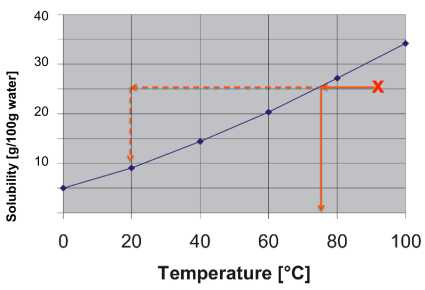
Reading up from 90°C on the x-axis and across from 25g per 100g of water on the y-axis, we tin can find the starting point on the graph (marked X). The solution contains 25g of solute, all dissolved, and isn't saturated. As the temperature decreases and the solution cools, nosotros move along horizontally on the graph until we reach the curve. At this temperature, 73°C, the solution is saturated. If we keep to absurd the solution, crystals will form as the mass of solute that can stay dissolved will get less. At 20°C we tin can see that 9g of solute will remain dissolved in the solution. This means all the rest of the solute (25g – 9g = 16g) will accept appeared equally crystals. The solution will still be saturated, though, and any more cooling will produce more crystals.

How To Read Solubility Chart,
Source: https://chemistryclinic.co.uk/1-6-plotting-and-interpreting-solubility-curves/
Posted by: moffettpenated.blogspot.com
0 Response to "How To Read Solubility Chart"
Post a Comment