

Characters In Joy Luck Club
 Start edition | |
| Author | Amy Tan |
|---|---|
| Country | Usa |
| Linguistic communication | English |
| Genre | Fiction |
| Publisher | G. P. Putnam's Sons |
| Publication appointment | 1989 |
| Pages | 288 |
| ISBN | 0-399-13420-four |
| OCLC | 18464018 |
| Dewey Decimal | 813/.54 19 |
| LC Form | PS3570.A48 J6 1989 |
The Joy Luck Club is a 1989 novel written by Amy Tan. It focuses on four Chinese immigrant families in San Francisco who start a club known as The Joy Luck Guild, playing the Chinese game of mahjong for money while feasting on a variety of foods. The volume is structured similarly to a mahjong game, with four parts divided into four sections to create 16 chapters. The 3 mothers and iv daughters (1 mother, Suyuan Woo, dies before the novel opens) share stories about their lives in the course of short vignettes. Each part is preceded by a parable relating to the themes within that section.
In 1993, the novel was adapted into a feature film directed by Wayne Wang and starring Ming-Na Wen, Lauren Tom, Tamlyn Tomita, French republic Nguyen, Rosalind Chao, Kieu Chinh, Tsai Chin, Lisa Lu, and Vivian Wu. The screenplay was written by the writer Amy Tan along with Ronald Bass. The novel was as well adapted into a play, by Susan Kim, which premiered at Pan Asian Repertory Theatre in New York.
Plot [edit]
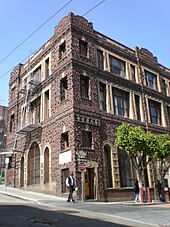
Outset Chinese Baptist Church at 15 Waverly Pl, San Francisco
The Joy Luck Club consists of xvi interlocking stories almost the lives of four Chinese immigrant mothers and their four American-built-in daughters.[1] In 1949, the iv mothers meet at the Get-go Chinese Baptist Church building in San Francisco and agree to proceed to meet to play mahjong. They call their mahjong group the Joy Luck Club. The stories told in this novel circumduct around the Joy Luck Club women and their daughters. Structurally, the novel is divided into 4 major sections, with ii sections focusing on the stories of the mothers and ii sections on the stories of the daughters.
Feathers from a Thousand Li Away [edit]
The first section, "Feathers from a Thousand Li Away", introduces the Joy Luck Lodge through daughter Jing-Mei Woo, whose late mother Suyuan Woo founded the Joy Luck Lodge, and focuses on the four mothers. Jing-Mei relates the story of how her mother Suyuan was the wife of an officeholder in the Kuomintang during World State of war 2 and how she was forced to abscond from her home in Kweilin and abandon her twin daughters. Suyuan afterwards constitute out that her get-go husband died. She later married Canning Woo and immigrated to the United States where their girl, Jing-Mei, was born. Suyuan and Canning attempted to find Suyuan'southward daughters, and Canning assumed that Suyuan had given up hope. Jing-Mei, who has been asked to take her female parent'south place in the Joy Luck Social club, learns from the other mothers that her half-sisters are alive. They ask that Jing-Mei go to China and meet her sisters, and tell them about Suyuan'southward death.
The other three mothers relate the stories of their childhood. An-Mei Hsu'southward story relates how her mother left her family to become the 4th concubine of Wu Tsing, a rich merchant, while An-Mei was raised by her maternal grandmother. Her female parent returns only to cutting off a slice of her mankind to cook a soup in hopes of healing An-Mei'south grandmother, though An-Mei'due south grandmother still dies.
Lindo Jong explains how in childhood she was forced into a loveless spousal relationship and was pressured by her mother-in-law'southward desire for Lindo to produce grandchildren. Through her own ingenuity, Lindo fabricates a disarming story to annul her marriage and immigrate to the Usa.
The final story of the first department follows Ying-Ying St. Clair, who tells the story of how she cruel into a lake during the Zhongqiujie festival when she was merely iv. After being rescued by a group of fishermen, she realizes that she is lost. This experience emotionally traumatizes her, and she is dropped at the shore, and wanders into an outdoor performance featuring the Moon Lady, said to grant wishes. But when Ying-Ying approaches the Moon Lady subsequently the play to wish to be returned to her family unit, she discovers the Moon Lady is played by a human.
Twenty-Six Malignant Gates [edit]
The second section traces the childhoods of the Joy Luck children. In the first story, Waverly Jong talks almost how she started playing chess, first with her brothers and and then with onetime men in the playground near her school. At the age of 9, she becomes a national chess champion. She is embarrassed when her mother, Lindo, introduces her to everyone she meets, showing her off like a trophy and seeming to take the credit for her daughter'southward luminescence. This leads to an angry confrontation betwixt the 2 of them.
Lena relates the stories her mother told her when she was younger (her nifty grandfather sentenced a beggar to die in the worst possible manner). Lena's family moves to North Hill from Oakland. Her mother, who seems restless, delivers an anencephalic child who dies at birth. In Lena's eyes, her female parent becomes a 'living ghost'.
The story of their neighbors and the relationship between the mother and the daughter of the neighboring household is likewise mentioned. Rose Hsu Jordan wishes to tell her female parent that she plans to divorce her married man Ted. She reflects on their relationship. She then goes on to relate an incident in which her family (her parents and six siblings) go to the beach. Her youngest blood brother, Bing, drowns. She returns forth with her mother An Mei to search for Bing, but in vain.
The concluding story is that of Jing Mei Woo and the force per unit area that her mother puts on her to perform exceedingly well in some field (to exist a child prodigy). She begins to larn to play the piano but does not perform well in a concert and stops playing. This disappoints her mother considering she wanted her to be a great pianist and Jing-Mei shows no interest in being anything else but herself. Around her 30th altogether, Suyuan presents her an old piano which she used to play as a child. Although Jing-Mei admits she had forgotten how to play the pianoforte, Suyuan encourages her to try once more. She admits to Jing-Mei that she still has the talent to be a great pianist, but self-doubt holds her back.
American Translation [edit]
The third section follows the Joy Luck children every bit developed women, all facing various conflicts. In Lena'due south story, she narrates her troubling marital problems and how she fears beingness inferior to her husband, Harold Livotny. She does not realize he has taken reward of her both at domicile and at work, where he is likewise her boss and earns much more than her. Ying-Ying is very much aware of this and breaks the leg of a table to symbolize that her union will crumble considering it has a weak foundation. Lena finally admits she is non happy in her matrimony to Harold and is lost inside. Ying-Ying encourages her to cease being passive and stand up to her hubby or nothing will change.
Waverly Jong worries about her mother's opinion of her white fiancé, Rich, and recalls quitting chess after becoming angry at her mother in the marketplace. She believes that her mother will still have absolute power over her and volition object to her forthcoming marriage to Rich, after she did the same to her previous husband, Marvin Chen, with whom she has a daughter, Shoshana. After a disastrous endeavor at a dinner party to tell her female parent of their nuptials, Waverly confronts her mother the morning afterward and realizes that her mother has known all along about her human relationship with Rich and has accepted him.
Rose Hsu Hashemite kingdom of jordan learns that Ted intends to marry someone else after divorcing her. She realizes through her mother's advice that she needs to fight for her rights and refuses to sign the conditions set forth past his divorce papers. She hires a practiced lawyer and wins possession of the house, forcing Ted to accept her more than seriously.
In Jing-Mei'south story, Jing-Mei has an argument with Waverly at a Chinese New year's day's dinner the twelvemonth before the story begins. Realizing that Jing-Mei has been humiliated, Suyuan gives her a special jade pendant chosen "life'south importance", which she has worn since Jing-Mei was an infant. Jing-Mei regrets that she never learned the significant of the pendant'south proper noun. She also confronts Suyuan with the belief that she had always been disappointed in Jing-Mei and admitted she could never live up to her high expectations. Jing-Mei believes that considering she has never finished higher, does not have a adept career, and remains unmarried, she is seen as a failure in her female parent's eyes. Suyuan eventually reveals her true meaning; that while Waverly has style, she lacks the kind and generous heart that Jing-Mei has. She also tells Jing-Mei that she understands the frustrations of never beingness adept enough in her eyes and admits she is proud of Jing-Mei.
Queen Mother of the Western Skies [edit]
The final section of the novel, the title of which refers to the Chinese goddess Xi Wangmu, returns to the viewpoints of the mothers as adults dealing with difficult choices. An-Mei reveals what happened afterwards her grandmother died, she angered her relatives past leaving with her female parent. They return to the home where her female parent lived as the abused fourth concubine of Wu Tsing, whose second concubine manipulates and controls the household and has taken An-Mei's one-half-brother as her son. An-Mei learns how her mother was forced into accepting her position subsequently Wu Tsing'south second wife arranged for An-Mei's mother to be raped and shamed. When she came to her family for assistance, they cruelly turned their backs on her female parent and told her to get out. An-Mei finds her female parent has poisoned herself two days before Chinese New Year, knowing that Wu Tsing'due south superstitious beliefs will ensure An-Mei volition grow upwards in favorable weather.
During the funeral, she takes her younger half-brother and forces Wu Tsing to honor both them and their deceased mother out of fearfulness of him being haunted by their female parent's ghost. The aroused 2d Married woman attempts to dispute her claims and tries to discredit her. An-Mei quickly makes an instance of her by destroying the fake pearl necklace that she originally gave to her, which exposes her cruelty and manipulation. This causes the 2nd Wife to realize that she has lost control of the household and brought trouble on herself, and then she backs downwards. Fearing bad karma on the style, Wu Tsing honors both An-Mei and her blood brother equally his children and their female parent as his favorite First Married woman.
Ying-Ying St. Clair reveals how her get-go husband, a womanizer, abandoned her and how she married an American man she did not love after relinquishing her sense of command in her life. She later took back her sense of control when she finally had a talk with Lena and convinced her to leave Harold.
Lindo Jong relates how she arrived in San Francisco and met An-Mei Hsu when they both worked at a fortune-cookie factory, which eventually gave her the means to plant the idea of marriage in her boyfriend's head.
The novel's terminal episode returns to Jing-Mei, and her mother's desire to notice her lost twin daughters. Jing-Mei and her begetter fly to China, where Jing-Mei meets her one-half-sisters and embraces her Chinese heritage. In doing and so, she was finally able to make peace with Suyuan.
Characters [edit]
Mothers [edit]
Suyuan Woo [edit]
During the Second World State of war, Suyuan lives in the Democracy of China while her husband at the time served equally an officeholder in Chungking (Chongqing). She starts the original Joy Luck Club with her three friends to cope with the War. At that place is petty to eat, simply they pretend it is a banquet, and talk about their hopes for the futurity. On the day of the Japanese invasion, Suyuan leaves her business firm with nothing but a purse of clothes, a handbag of food, and her twin baby daughters.
During the long journey, Suyuan contracts such astringent dysentery that she feels sure she will die. Fearing that a dead mother would doom her babies' chances of rescue, she reluctantly and emotionally leaves her daughters under a barren tree, together with all her belongings, along with a notation asking anyone who might detect the babies to care for them and contact the father. Suyuan then departs, expecting to die. All the same, she is rescued past a truck and finds out her married man has died. She later on remarries, goes to America, and forms a new Joy Luck Social club with iii other Chinese female person immigrants she met at church. She gives nascency to another daughter, only her abandonment of her twin girls haunts her for the rest of her life. After many years, Suyuan learns that the twins were adopted, but dies of a brain aneurysm before she can come across them. Information technology is her American-built-in girl Jing-mei who fulfills her long-cherished wish of reuniting with them.
As Suyuan dies earlier the novel begins, her history is told past Jing-mei, based on her knowledge of her mother'south stories, anecdotes from her father, and what the other members of the Joy Luck Club tell her.
An-Mei Hsu [edit]
An-Mei is raised by her grandparents and other relatives during her early years in Ningbo subsequently her widowed mother shocks the family unit by becoming a concubine to a center-aged wealthy homo after her first hubby's death. This becomes a source of disharmonize for the young An-Mei, equally her aunts and uncles deeply resent her female parent for such a dishonorable deed. They try to convince An-Mei that it is not plumbing fixtures for her to live with her disgraced mother, who is at present forbidden to enter the family home. An-Mei'south mother, however, all the same wishes to be part of her daughter's life. After An-Mei'due south grandmother dies, An-mei moves out to live with her mother in the habitation of her mother's new husband, Wu-Tsing, much to the disagreement of her relatives who insists she remains at home with them.
An-Mei learns that her mother was coerced into existence Wu-Tsing'southward concubine through the manipulations of his Second Wife, the favourite. This woman arranged for An-Mei's mother, still in mourning for her original married man, to be raped by Wu-Tsing. When her mother came to her family for their assistance, they cruelly refused and disowned her. The stigma left An-Mei's female parent with no choice but to ally Wu-Tsing and become his new but lowly Fourth Married woman. She later lost her babe son to Second Wife, who claimed the boy as her own child to ensure her place in the household. Second Wife also tried to win over An-mei upon her arrival in Wu-Tsing'southward mansion, giving her a necklace fabricated of "pearls" that her mother later revealed were really glass beads, by crushing one with her teacup. An-Mei's mother re-knots the necklace to hide the missing dewdrop, just now An-Mei knows the truth about 2d Married woman's seeming generosity.
Wu-Tsing is a highly superstitious man, and Second Married woman takes advantage of this weakness past making false suicide attempts and threatening to haunt him every bit a ghost if he does non let her have her style. According to Chinese tradition, a person's soul comes back after three days to settle scores with the living. Wu-Tsing, therefore, is known to exist afraid to face the ghost of an aroused or scorned wife. Afterwards Second Wife fakes a suicide endeavour to prevent An-Mei and her mother from getting their ain modest house, An-Mei'southward mother successfully commits suicide herself, eating tangyuan laced with lethal amounts of opium. Also taking reward of Wu Tsing's beliefs, she times her expiry so that her soul is due to return on the first 24-hour interval of the Lunar New Year, a day when all debts must be settled lest the debtor endure neat misfortune. An-Mei takes her younger blood brother'southward arm and demands that Wu Tsing honor them and her mother or face dandy consequences. When Second Wife attempts to dispute this at the funeral rites, An-Mei quickly makes an example of her and shows her awareness of Second Wife's deceptions past crushing the fake pearl necklace under her feet. This symbolizes her new power over the woman who fabricated her mother'south life miserable past abusing her and taking her brother away. Now fearing An-Mei, Second Wife realizes the bad karma she has brought upon herself and backs downward, having lost command of the firm. With this in mind, Wu-Tsing promises to treat his Fourth Wife's children, including An-Mei, as if they were his very own flesh and blood and their mother equally his honored First Married woman.
An-Mei later immigrates to America, marries, and gives birth to vii children (4 sons, three daughters). The youngest, a son named Bing, drowns at age iv.
Lindo Jong [edit]
Lindo is a strong-willed adult female, a trait that her daughter Waverly attributes to her having been built-in in the twelvemonth of the Horse. When Lindo was only twelve, she was forced to move in with a neighbor'southward young son, Huang Tyan Yu, through the machinations of the village matchmaker. After some training for household duties through her in-laws, she and Tyan-yu married when she turned sixteen. She presently realized that her husband was a mere male child at eye and had no sexual interest in her. It is loosely implied that he might accept been gay. Lindo began to intendance for her husband as a brother, but her roughshod mother in law expected Lindo to produce a grandson. She restricted most of Lindo'due south daily activities, eventually ordering her to remain on bed rest until she could excogitate and evangelize a kid.
Determined to escape this unfortunate situation, Lindo carefully observed the other people in the household and somewhen formed a clever program to escape her marriage without dishonoring herself, her family and her in-laws. She managed to convince her in-laws that Huang Tyan Yu was actually fated to marry another girl who was already pregnant with his "spiritual child", and that her own union to him would only bring bad luck to the family unit. The girl she described every bit his destined wife was, in fact, a mere servant in the household, indeed pregnant but abandoned by her lover. Seeing this every bit an opportunity for her to be married and live comfortably, the servant girl cheerfully agreed with Lindo.
Freed from her beginning marriage, Lindo decided to immigrate to America. She married a Chinese American man named Tin Jong and has three children: sons Winston and Vincent, and daughter Waverly.
Lindo experiences regret over losing some of her Chinese identity by living so long in America (she is treated similar a tourist on a visit to Mainland china); all the same, she expresses business that Waverly's American upbringing has formed a barrier between them.
Ying-Ying "Betty" St. Clair [edit]
From a young age, Ying-Ying is told by her wealthy and conservative family that Chinese girls should be meek and gentle. This is specially difficult for her, as she feels it out of pace with her character as a Tiger. She begins to develop a passive personality and represses her feelings as she grows upwards in Wuxi. Ying-Ying marries a charismatic man named Lin Xiao not out of dearest, just considering she believed information technology was her fate. Her husband is revealed to be abusive and openly has extramarital affairs with other women. When Ying-Ying discovers she is pregnant, she has an abortion and decides to live with her relatives in a smaller city in China.
Afterward ten years, she moves to Shanghai and works in a clothing store, where she meets an American man named Clifford St. Clair. He falls in love with her, merely Ying-Ying cannot express whatever strong emotion later on her kickoff marriage. He courts her for 4 years, and she agrees to marry him afterwards learning that Lin Xiao had died, which she takes as the proper sign to movement on. She allows Clifford to control nearly aspects of her life; he mistranslates her words and actions, and even changes her name to "Betty". Ying-Ying gives birth to her daughter, Lena, after moving to San Francisco with St. Clair. When Lena is around ten years old, Ying-Ying becomes pregnant a third time, merely the baby male child is anencephalic and soon dies.
Ying-Ying is horrified when she realises that Lena, a Tiger like herself, has inherited or emulated her passive behaviors and trapped herself in a loveless spousal relationship with a controlling married man. She finally resolves to call upon the more than believing qualities of her Tiger nature, to entreatment to those qualities in Lena. She will tell Lena her story in the promise that she will exist able to interruption free from the same passivity that ruined well-nigh of her immature life back in Red china.
Daughters [edit]
Jing-Mei "June" Woo [edit]
Jing-Mei has never fully understood her mother and seems directionless in life. During Jing's childhood, her female parent used to tell her that she could be annihilation she wants; still, she particularly wanted her girl to be gifted, a child star who amazes the world, like Ginny Tiu (seen briefly on television) or June's rival Waverly. At the beginning of the novel, June is chosen to replace her female parent'due south seat in the Joy Luck Club afterwards her mother'southward death. At the end of the novel, June is even so trying to deal with her female parent's death, and she visits Red china to see the twin one-half-sisters (Wang Chwun Yu and Wang Chwun Hwa) whom her mother had been forced to abandon when the Japanese attacked China. Only when she visits China to meet her half-sisters and tell them near their mother, Jing-Mei finally accepts her Chinese heritage and makes her peace with her mother.
One critic[ who? ] has suggested[2] that the reason for the communication gap between Jing-Mei and her female parent, and between the other daughters and their mothers—a major theme of the novel—occurs because the mothers come from a high context civilization and the Americanized daughters from a depression context culture. The mothers believe that the daughters will intuitively empathize their cryptic utterances, but the daughters don't empathize them at all.
Rose Hsu Jordan [edit]
Rose is somewhat passive and is a bit of a perfectionist. She had an unsettling childhood feel when her youngest brother, Bing, drowned while she was supposed to be watching him, and his torso was never recovered. Rose marries a dr., Ted Jordan, who loves her only also wants to spite his snooty, racist mother. After a malpractice arrange, Ted has a mid-life crisis and decides to leave Rose. Rose confides in her mother and An-mei tells her the story of her own childhood. When Ted comes for the divorce papers, Rose finds her vocalisation and tells him that he tin can't just throw her out of his life, comparing herself to his garden, once so beloved, at present unkempt and total of weeds. An-Mei tells her that Ted has been adulterous on her, which Rose thinks is absurd, only she later discovers this to be true. She hires a good lawyer and fights for possession of the house, which she eventually wins. This forces Ted to take Rose more seriously and not keep taking her for granted. Information technology's unknown if they ever reconciled.
Waverly Jong [edit]
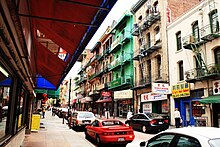
Waverly Jong is named for (and grew upwardly on) Waverly Place in San Francisco's Chinatown
Waverly is an independent-minded and intelligent adult female, merely is annoyed by her mother's constant criticism. Well into her adult life, she finds herself restrained by her subconscious fright of letting her mother down. During their childhood, June and Waverly get babyhood rivals; their mothers constantly compared their daughters' development and accomplishments. Waverly was in one case a gifted chess champion, but quit after feeling that her female parent was using her daughter'due south talent to show off, taking credit for Waverly'south wins. Waverly does not necessarily understand the origin of her female parent'southward comments or what context for which they are intended. Waverly is "unable to feel at home in… [her] relationship with [her] female parent."[three]
She has a daughter, Shoshana, from her showtime marriage with Marvin Chen, and she is engaged to her boyfriend Rich Schields. When Waverly believes that Lindo will object to her date to Rich after a failed dinner political party, she discovers her mother had already accustomed it.
Lena St. Clair [edit]
Throughout Lena's childhood, she gradually becomes her mother's vocalization and interprets her mother'southward Chinese words for others. Like her father Clifford, she translates Ying-ying'due south words to sound more than pleasant than what Ying-ying actually says. Ying-ying has taught Lena to beware of consequences, to the extent that Lena visualizes disaster in the taking of any chance. Lena's husband, Harold, is as well her boss. He takes the credit for Lena's concern and design ideas. He demands financial "equality" in their union. Lena is an acquaintance while Harold is a partner, so he has a larger salary than she does. However, he insists that all household expenses be divided equally between them. Harold believes that by making everything equal, they tin can make their love equal as well. Lena feels frustrated and powerless. She settles for what Harold tells her is right: "in Chinese society…the man is the one who creates the rules and the woman… has no choice [except] obeying these rules."[4] Harold'south deed of dictatorship over Lena could be the reason for her created self-doubt: "in…patriarchy, men possess the highest status... so that women's position is subordinate to them."[v] She is like her mother, similar a ghost, and her female parent wants to help her regain her spirit and stand up for herself. When Ying-Ying breaks a leg from a table belonging to Harold, Lena finally admitted she'due south unhappy in her marriage including how frustrated she is with him for taking credit for her concern and design ideas. Ying-Ying encourages her to go out Harold and not come back until he treats her with more respect.
Reception [edit]
While The Joy Luck Guild earned loftier praise, it also received criticism for perpetuating racist stereotypes about Asian Americans.[vi] [7] Literary figures such equally Chinese American writer Frank Mentum said that information technology depicted Chinese culture as backwards, cruel, and misogynistic. He attributed the popularity of The Joy Luck Club to playing up racist stereotypes welcomed in mainstream America.[viii] He likewise noted that it lacks authenticity for its made Chinese folk tales that describe "Confucian culture as seen through the interchangeable Chinese/Japanese/Korean/Vietnamese mix (depending on which is the yellow enemy of the moment) of Hollywood."[nine] [10]
Harvard Crimson writer, Allen Soong, reflected that "while the women ... are fully fleshed-out characters who are a remarkable comeback over the "exotic Oriental" Cassandra from Wayne's World, the male person characters are merely additions to the long list of negative images of Asian men in our culture."[11]
Novelist Nancy Willard, in a somewhat positive critique, said that "Amy Tan'south special accomplishment in this novel is not her ability to show u.s. how mothers and daughters hurt each other, just how they love and ultimately forgive each other."[12]
The act of losing individuality continues through multiple generations because the mothers in Tan'due south story "never offering physical anecdotes to teach [their daughters]" about their feelings and their pasts.[13] The daughters spend a large portion of their lives feeling lost and trying to empathize their place in social club. Their "search for an essential Chinese identity... always frustrate[d] their attempts to sympathise... their identities."[14]
Carolyn See of the Los Angeles Times gave the novel a positive review, stating "The simply negative affair I could always say about this book is that I'll never again be able to read it for the first time."[xv]
References [edit]
- ^ "Joy Luck Club Summary". SparkNotes. Archived from the original on 3 March 2017. Retrieved 2 March 2017. (in English)
- ^ "Amy Tan: Overview". academic.brooklyn.cuny.edu.
- ^ Woods, Michelle Gaffner. "Negotiating the Geography of Mother-Girl Relationships in Amy Tan's The Joy Luck Order." The Midwest Quarterly, no. 1, 2012, p. 82.
- ^ Tanritanir, Bülent Cercis, and Gamze Görürüm. "Struggle for an Identity in Amy Tan'south The Joy Luck Club." Periodical of International Social Inquiry, vol. x, no. 48, Feb. 2017, pp. 123–128.
- ^ Afandi, Mujad Didien. "The Shift in Gender Roles in Amy Tan's The Joy Luck Society and Khaled Hosseini'south The Kite Runner." Lensa, Dan Budaya, vol. eight, no. one, 2018. pp 1-21.
- ^ Chin, Frank (2005). "Chapter 8: Come All Ye Asian American Writers of the Real and the Fake". In Kent A. Ono (ed.). A companion to Asian American studies. Wiley-Blackwell. pp. 134–135. ISBN9781405137096.
- ^ Yu, Philip (August 26, 2010). "Chinky Or Not Chinky: Do Asian American Authors Have An Anti-Asian Male Bias?". You Offend Me You Offend My Family. YOMYOMF. Retrieved August 11, 2018.
- ^ Fei, Deanna (May 25, 2011). "I Called Amy Tan A Muddied Word—So She Friended Me". Huffington Post . Retrieved Baronial 11, 2018.
- ^ Ono, Kent A. (x December 2004). A Companion to Asian American Studies. Wiley. ISBN9781405115957 – via Google Books.
- ^ TANAKA Tomoyuki (1995). "REVIEW: THE JOY LUCK CLUB" – via Google Groups.
- ^ Soong, Allen (Oct 8, 1993). "Unaccepted Images". Harvard Reddish . Retrieved August 11, 2018.
- ^ Willard, Nancy (July 1989). "Tiger Spirits". The Women'southward Review of Books. 6 (10): 12. doi:10.2307/4020553. JSTOR 4020553.
- ^ Manjula, Thousand., and Govindaraj, C. "The Challenges of Cultural Translation and the Problems of Immigrant Identity in Amy Tan's The Joy Luck Order." Linguistic communication in India, vol. 18, no. 12, Dec. 2018, pp. 184–188.
- ^ Woods, Michelle Gaffner. "Negotiating the Geography of Mother-Daughter Relationships in Amy Tan's The Joy Luck Club." The Midwest Quarterly, no. 1, 2012, p. 82.
- ^ "Drowning in America, Starving for China : THE JOY LUCK Order by Amy Tan (G.P. Putnam'southward Sons: $18.95; 277 pp.)". Los Angeles Times. 1989-03-12. Retrieved 2019-08-23 .
External links [edit]
- The Joy Luck Society report guide, themes, quotes, education guide

Characters In Joy Luck Club,
Source: https://en.wikipedia.org/wiki/The_Joy_Luck_Club_(novel)
Posted by: moffettpenated.blogspot.com
0 Response to "Characters In Joy Luck Club"
Post a Comment